Tendance scans every liquid coin against fixed, mechanical rules — then publishes the entire result. The ones that passed, the ones that didn't, and the exact test each one failed on. No calls. No predictions. No thumbnails.
Free while the token is unlaunched · Sign in with a wallet · No email, no password

Crypto content is dominated by loud opinions, exaggerated predictions, clickbait thumbnails, and self-proclaimed experts who often lack a serious understanding of market data.
They use fear, hype, and FOMO to generate attention. They publish confident calls without showing the data behind them. When the analysis fails, there is no accountability — only another prediction, another narrative, and another opportunity to farm engagement.
Many creators are rewarded for being entertaining, not accurate. Some promote assets they are paid to discuss, while others repeat popular narratives without properly studying market structure, liquidity, price action, or risk.
For traders, this creates a dangerous environment.
The signal is buried beneath noise. Opinions are presented as facts. Promotions are disguised as analysis. The loudest voice often receives the most attention, regardless of whether the data supports the claim.
It needs transparent, accountable, data-driven intelligence that allows traders to understand what is actually happening — and why.
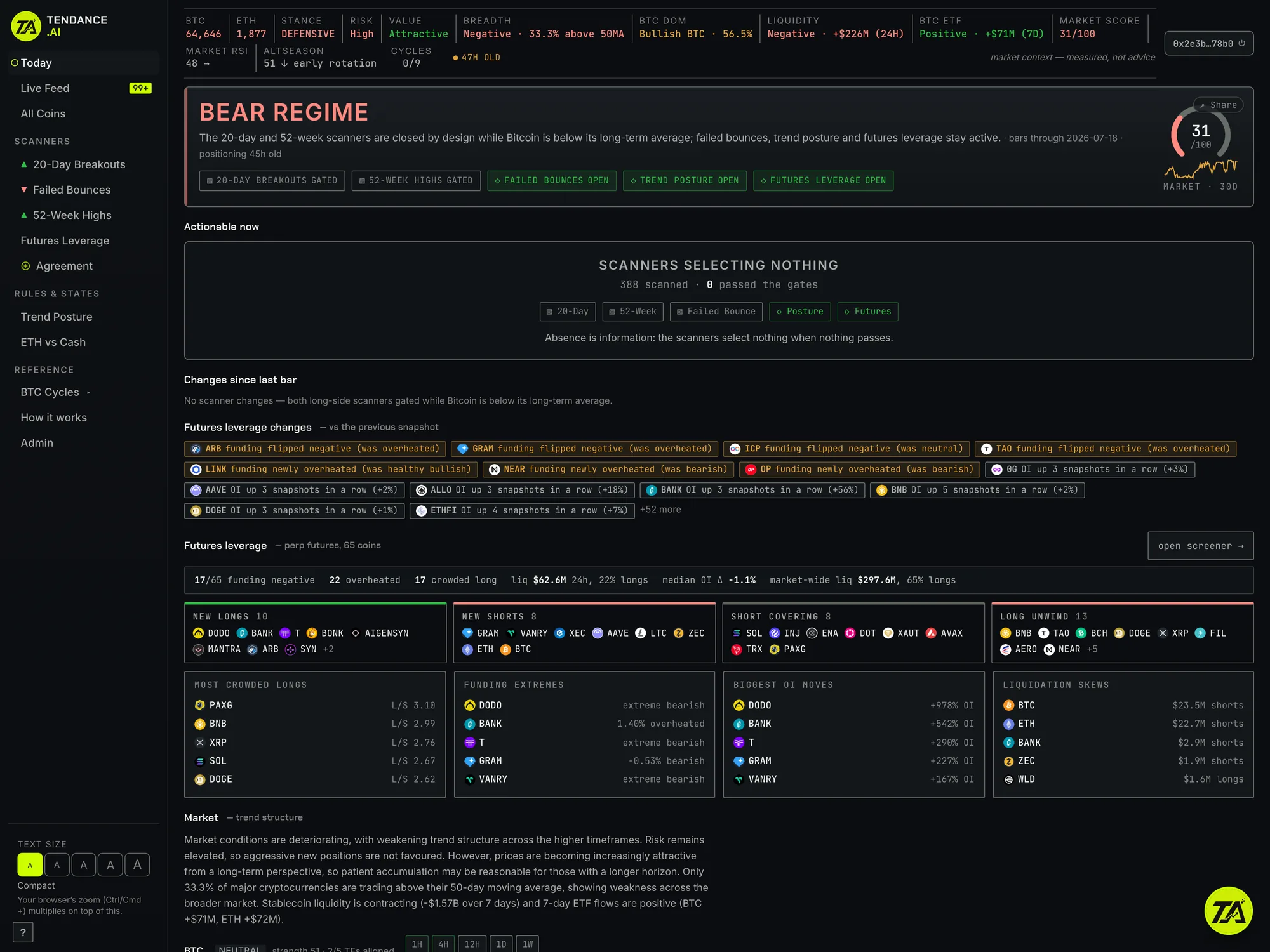
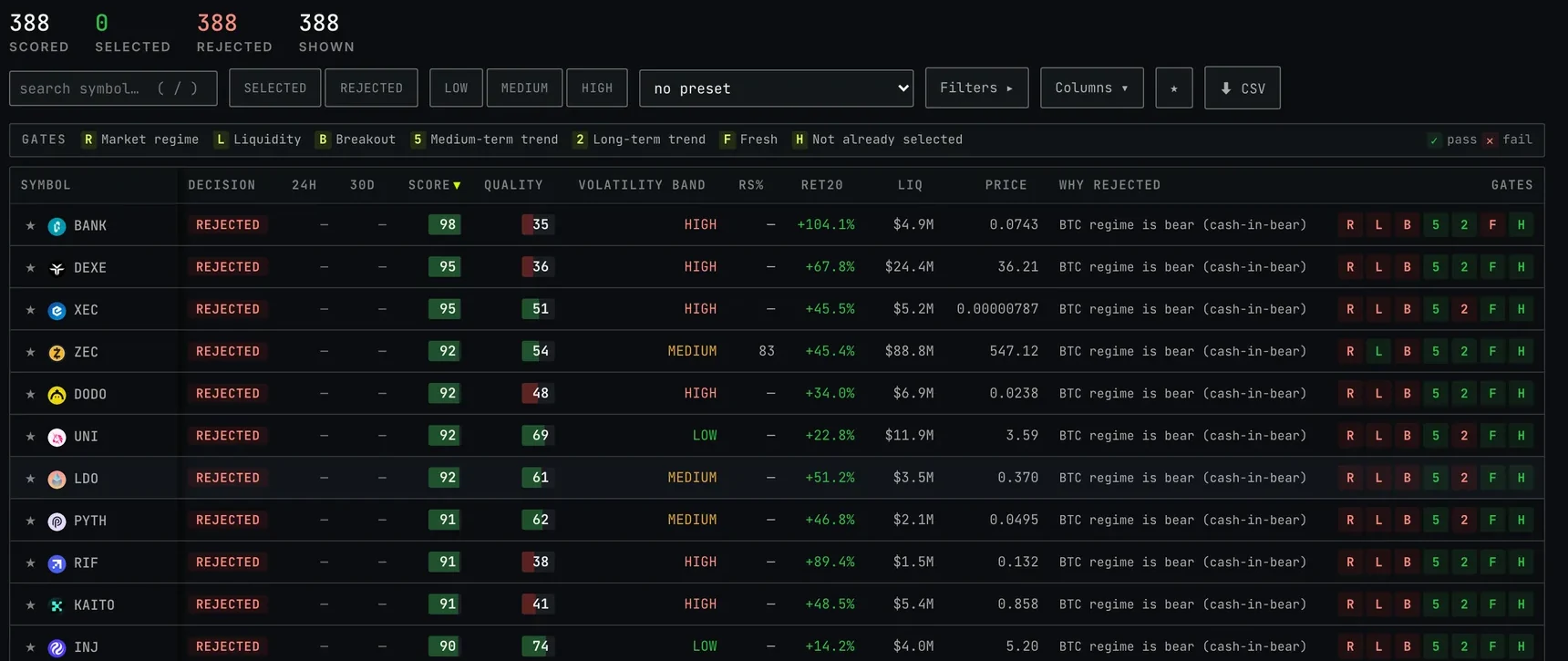
On this bar, all 388 coins failed. A channel with a posting schedule would have found something to talk about anyway. The terminal just says so — and then shows you the test that closed the door.
Every rejected row carries the first gate it failed — here, the market-regime gate R, because Bitcoin was below its long-term average. Nothing is hidden behind a "premium" tier, and nothing is quietly dropped because it spoils the story.
R market regime · L liquidity · B breakout · 5 medium-term trend · 2 long-term trend · F fresh · H not already selected
20-Day Breakouts, 2026-07-18 — the full scored field, rejections included.
Everything is computed from stored market data on a fixed schedule, labelled with what it measures, and stated in plain language. You never have to take our word for anything — the working is on screen.
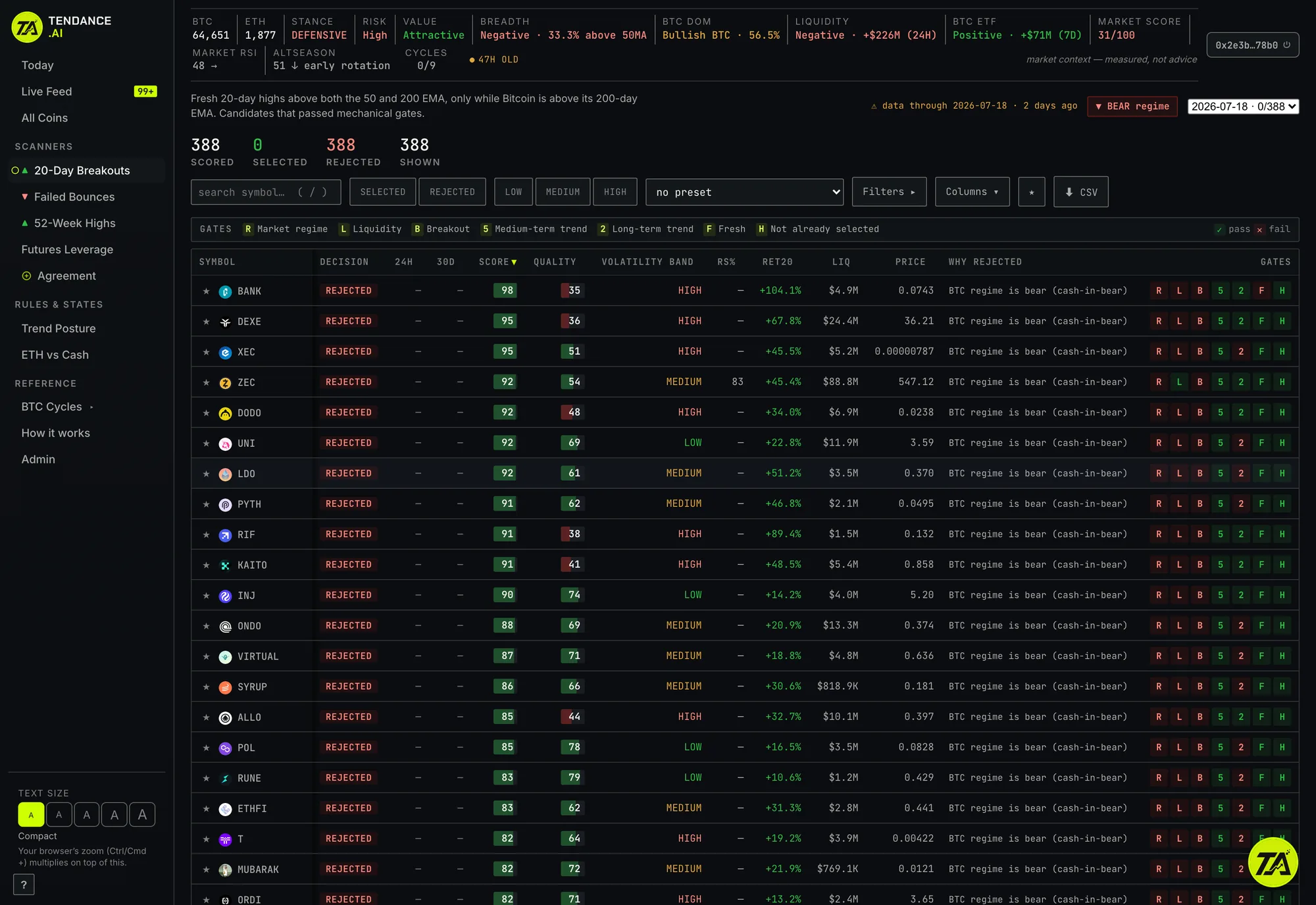
20-Day Breakouts, Failed Bounces and 52-Week Highs each run a chain of pass/fail tests over the whole universe. A coin is selected only if it clears every gate, and a rejected coin shows the first gate it failed. When a gate closes the scanner, the scanner goes quiet instead of lowering the bar.

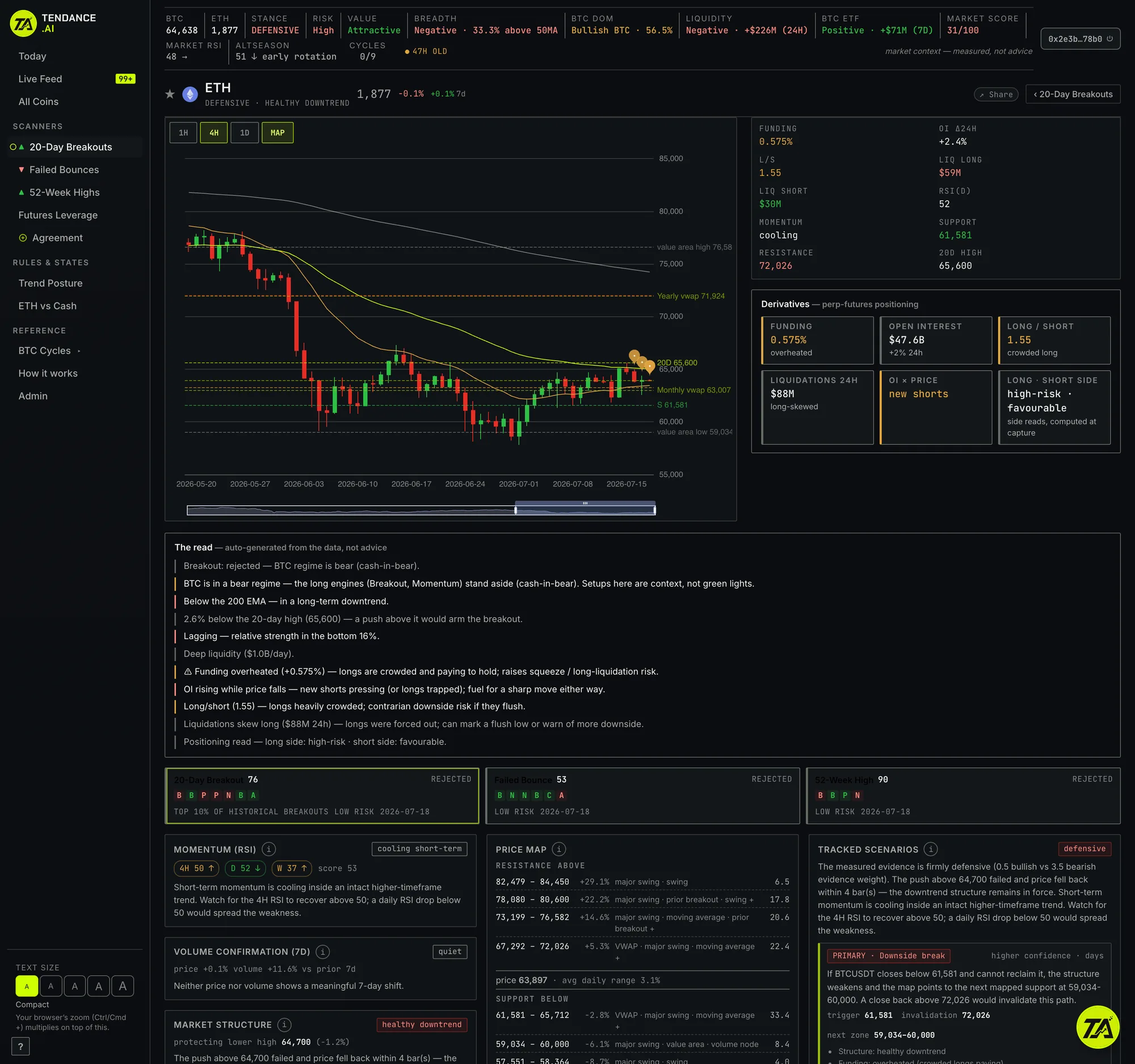
Price and volume with the levels the rules actually recorded, a plain-language read of the current state, futures positioning, the price map, scenario paths with their invalidation levels, and the full scoring history. Each scenario names the level that would prove it wrong.

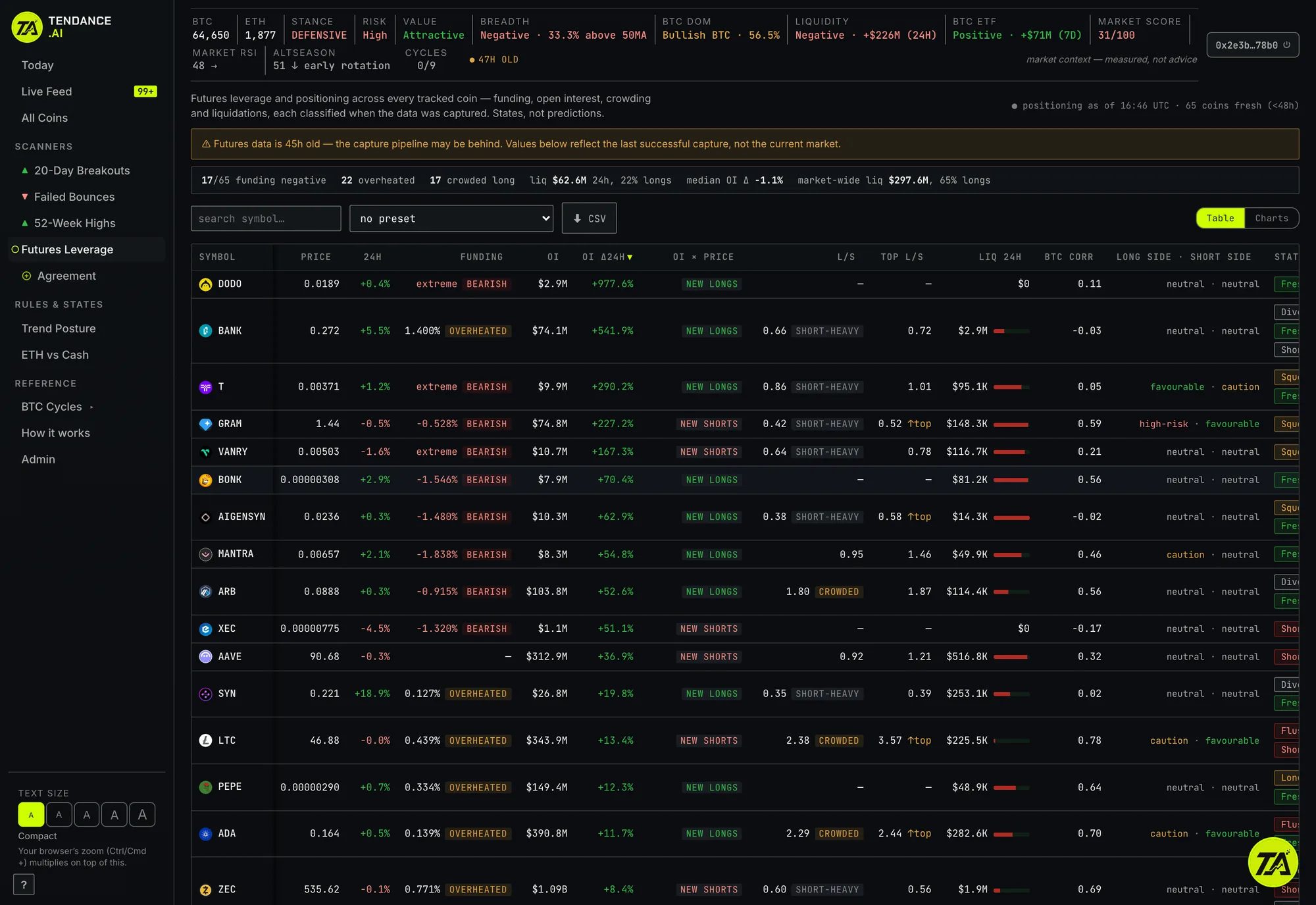
Funding rates, open interest and its 24-hour change, long/short crowding and liquidations across every coin with a perpetual market. Read as a description of positioning — crowded, paying, forced out — never as a directional call.

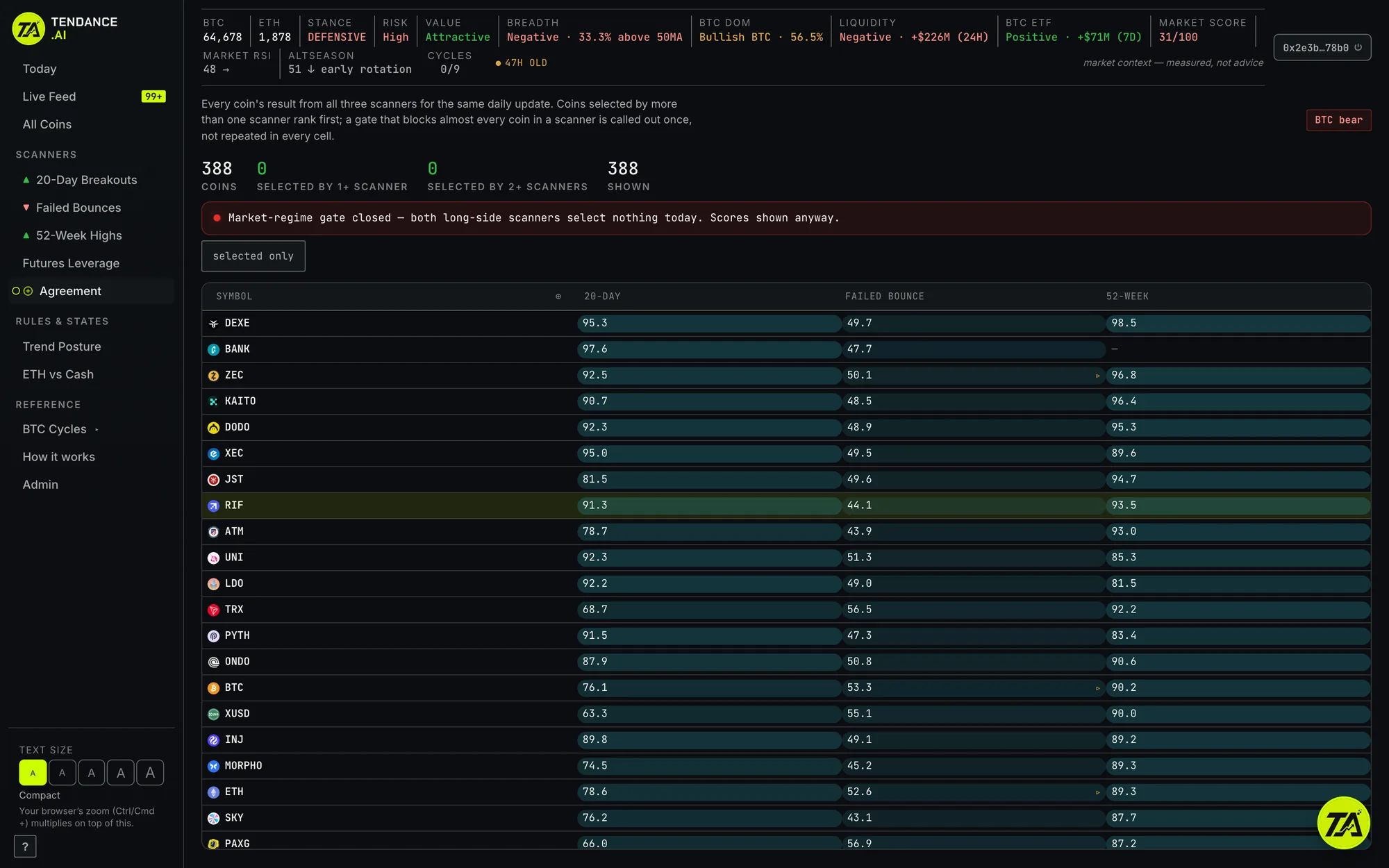
Every coin's result from all three scanners, side by side, for the same daily update. And a line we keep on the screen itself: agreement is not confirmation. Three rules built from the same price history concurring is not three independent opinions, and the product says so rather than selling it as conviction.

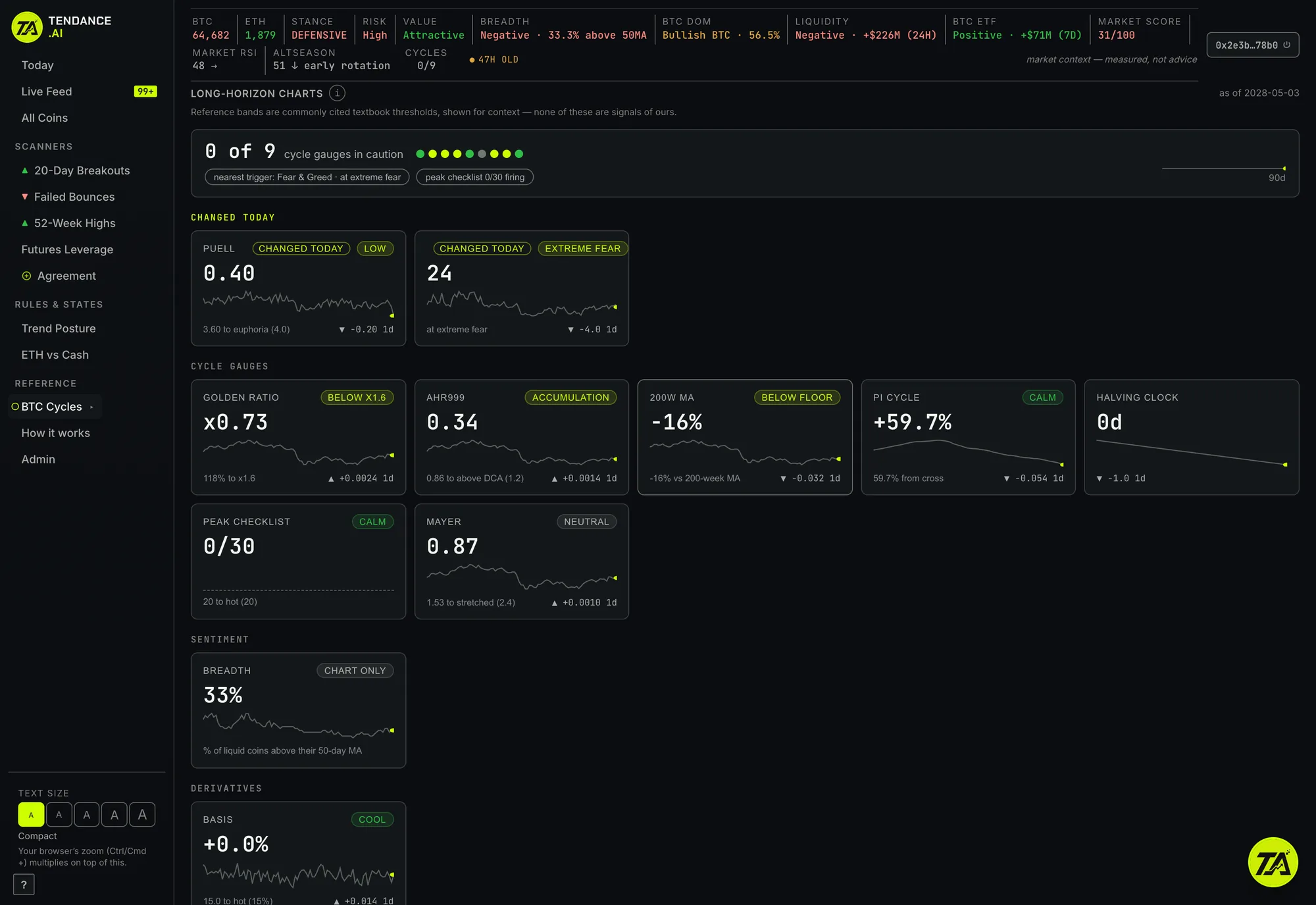
Ten widely cited Bitcoin cycle gauges — Pi Cycle, Puell, Mayer, the 200-week average and others — with their commonly cited reference bands. We show them because people use them, and we say plainly on the page that the bands are the community's, not ours, and that we do not backtest them.

Ask what a gate tests, why a scanner is empty, or what open interest actually counts, and you get a plain-language answer that defines its terms and points you at the right tab. Ask it whether to buy something and it declines — then offers what is measured instead. That refusal is the product working, not a limitation.
ASKED: "SHOULD I LONG BTC HERE?"
“I don't make calls on what to buy or sell — that isn't what this terminal does. What I can do is explain what's actually measured: whether the Bitcoin trend currently allows the long scanners to run, which gate a coin failed and what that gate tests, or how crowded futures positioning has become.”
Verbatim from the shipped assistant.
Most of the trust problem is not what a tool shows you — it's what it quietly leaves out. These are constraints written into the product, not promises in a marketing page.
There is deliberately no win-rate field anywhere in the product. A number we cannot stand behind is worse than no number.
When the gates close, the list is empty and the screen says so. Absence is information: the scanners select nothing when nothing passes.
The 52-week-high scanner is labelled fat-tailed and outlier-dependent in the product itself, because that is what its backtest showed.
The cycle gauges carry a standing note that the reference bands are commonly cited community thresholds, not signals we produce or backtest.
The universe is fixed and the rules are mechanical. There is no slot to purchase, because there is no editorial decision to influence.
Scores are research instrumentation. Everything on screen is a measurement of what already happened — never a forecast, and never a recommendation.
Once per daily bar, the whole tracked universe runs through each rule set. Nothing is cherry-picked, because nothing is picked by hand at all.
Passed and failed alike, with percentile scores ranked against the field and the first failing gate attached to every rejection.
Open any coin for the levels, positioning and scenarios behind its result — or ask the built-in analyst to walk you through the mechanics.
At launch, access to the terminal is gated on holding $TENDANCE on Robinhood Chain, and the same tokens double as usage credits for the built-in analyst. The token has not launched yet and we have no date to share — so the terminal is open to everyone in the meantime. We won't speculate on price, supply, or timing.
Not yet deployed — published here at launch
Open the terminal and check today's scan yourself — including the coins that didn't make it, and exactly why.
Wallet sign-in · Nothing custodial · Free while the token is unlaunched